What Actually Happens When Your Computer Executes a Program
We click “Run” and expect magic. But inside your computer, there’s a precise, lightning-fast process unfolding and it starts long before the CPU gets involved.
Let’s zoom in on the moment where software becomes action.
Step 0: Translation Begins – Compiler vs Interpreter
Before the CPU can do anything, it needs instructions in its own language: machine code (1s and 0s).
But we write software in human-friendly languages like Python, Java, or C++.
So the computer uses one of two translators:
🔹Compiler
Takes the entire program and translates it before execution.
Result: a binary file full of machine instructions.
🔹Interpreter
Translates and executes the code line by line, as it runs.
Result: real-time translation and execution.
Either way, the CPU ends up with a stream of precise instructions it can understand.
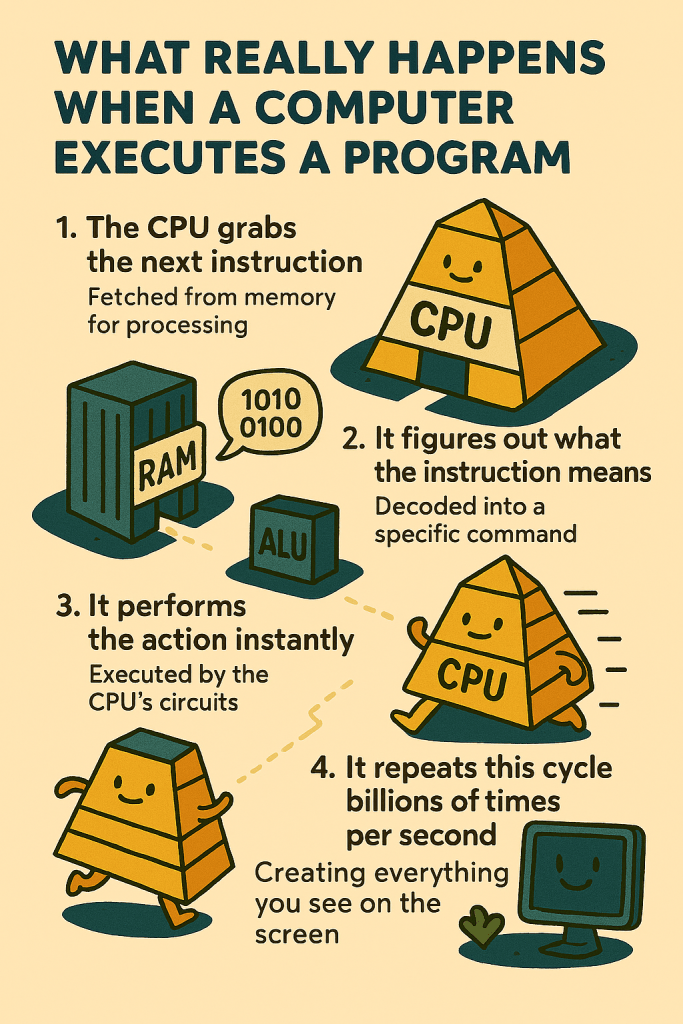
Step 1: The CPU grabs the next instruction
This is called the fetch step.
The CPU reaches into memory and pulls in the next instruction like grabbing the next step in a recipe.
Step 2: It figures out what the instruction means
This is the decode step.
The CPU reads the instruction and decides:
- Should I add two numbers?
- Move data?
- Jump to another part of the program?
It’s like reading the recipe and understanding what to do next.
Step 3: It performs the action — instantly
This is the execute step.
The CPU uses its internal circuits to do the work:
- The ALU handles math and logic
- The registers hold tiny bits of data
- The control unit keeps everything in sync
It’s fast, precise, and happens billions of times per second.
Step 4: It repeats — again and again
The CPU doesn’t stop.
It loops through fetch → decode → execute endlessly, turning software into action.
Step 5: You see the result
All those tiny steps add up to something big:
- A window opens
- A message appears
- A game character jumps
- A video plays
It’s the smallest actions, repeated at incredible speed, that make your computer feel alive.
The big idea
Execution isn’t one big action.
It’s a chain reaction starting with translation, flowing through the CPU, and ending with something you can see and use.
#TechExplained #DigitalLiteracy #ComputingBasics #Compiler #Interpreter #ExecutionCycle #STEM #LinkedInLearning
 Technology Insights
Leave a comment